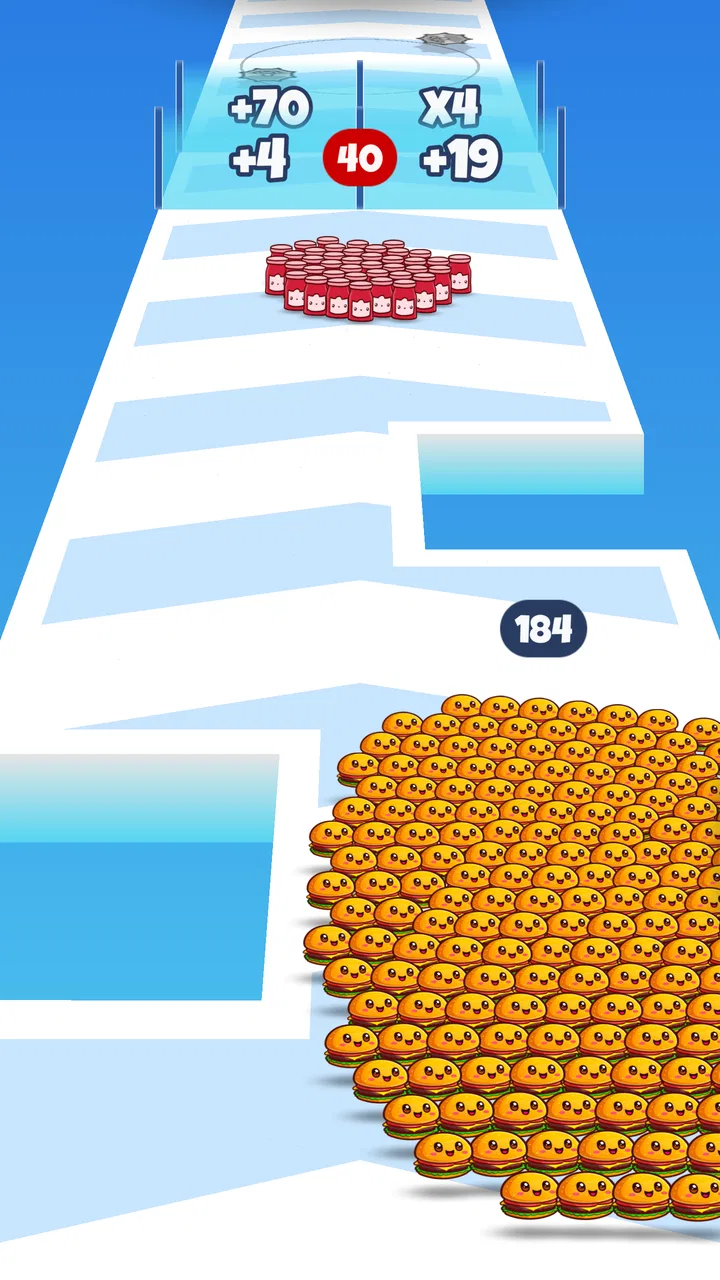
Food Run - Crowd Control Game
- 4.7
- Rating
- 50.00M
- Installs
- Free
- Price

 Analysis by App-foxy
I went into Food Run - Crowd Control Game expecting a quick action game built around a silly food theme, and that is exactly where its appeal begins. You guide a growing crowd of food items, keep moving through the course, and try to turn the chaos into a useful advantage by getting foods to feed one another. The idea is easy to understand within moments, but the best runs depend on paying attention rather than simply holding a direction and hoping for the best.
That makes it a comfortable choice for short sessions. I can play it when I have a few spare minutes, restart quickly after a poor run, and understand what went wrong without studying a complicated rulebook. At the same time, the crowd-control focus gives the game more decision-making than its playful presentation first suggests. The central question is not only how to move forward, but how to manage the group so that the next opportunity to grow is still available.
A simple first run that teaches the important habit
The developer is Diced Pixel, LLC, and the game sits in the action category. Its presentation is aimed at immediate interaction: move, collect or consume what is useful, avoid wasting the crowd, and reach the next part of the course with enough momentum to continue. I found that the first few attempts are most useful when treated as practice rather than as a test of reflexes.
You May Also Like

 Blood Strike: 2.5 Anniversary
Blood Strike’s Loadouts Turn Every Drop Into a Tactical Gamble
A close look at Blood Strike’s custom loadouts: how fast access to signature weapons reshapes its battle royale rhythm, rewards preparation, and narrows the gap between fights.

 Pandora - Music & Podcasts
Pandora’s Music Is Easy to Start, but Harder to Recover
Pandora’s strength is its low-effort path from a seed to a station. Its weak spot is how much confidence it asks you to place in connection, setup, and quiet recovery.

 8 Ball Pool
 Is Built on Rivalries, Rematches, and Routine
A close look at the rivalries, rematches, shared routines, and unanswered safety questions that turn a quick pool match into a persistent mobile community.

 Samsung Music
’s Quiet Strength Is Playing What You Already Own
Its reach comes less from spectacle than from dependable access to a personal library. That simplicity is both the app’s strongest retention engine and its ceiling.

 AccuWeather: Weather Radar
AccuWeather Review: A Quick, Clear Forecast for Everyday Decisions
For everyday plans, the best forecast is the one you can understand quickly. AccuWeather makes rain timing, radar, and local conditions easy to act on, with a few trade-offs.

 Hill Climb Racing
Why Hill Climb Racing Still Turns Crashes Into One More Run
A tiny car, a bumpy hill and one more upgrade: Hill Climb Racing keeps resurfacing because its simple chaos makes every near-miss feel personal.
More From Our News Desk



My basic workflow is to watch the path just ahead of the group, identify the safest useful target, and make a small movement instead of a dramatic one. Large corrections are tempting when the crowd becomes busy, but they often create a second problem immediately afterward. A controlled line gives me more time to see whether the next food is worth pursuing or whether it would pull the group into a poor position.
The food theme keeps the tone light, but the crowd itself creates the real challenge. A single item can be easy to steer; a large collection is less forgiving. The more I focus on the whole group instead of the item at the front, the more consistent my runs become. This is an important distinction for new players: the visible leader is not the only thing that matters, because a careless turn can leave part of the crowd behind or make the next choice awkward.
The store summary describes a game where thousands of foods run and feed one another, and that concept is reflected in the way the action escalates. I would not describe it as a traditional level-based action game with a deep combat system. It is closer to a fast arcade challenge in which positioning, timing, and crowd management carry the experience.
What I check before trying to improve a run
Because the game is designed for quick play, I recommend spending a moment checking the available settings before chasing better results. The most important adjustment is usually the control feel. If movement feels too sensitive, I make shorter swipes or taps and keep my hand closer to the center of the screen. If the response feels slow, I use earlier inputs rather than trying to compensate with a sudden long gesture.
I also pay attention to sound and visual distractions. Food Run is colorful and deliberately busy, so reducing anything that makes the screen harder to read can help during crowded sections. I prefer a presentation that lets me distinguish the path and the group immediately. This is not about making the game look less fun; it is about ensuring that decoration does not hide the next decision.
Another practical setting is the way I hold the phone. A two-handed grip gives me more precise control during a serious attempt, while one-handed play is perfectly suitable for casual runs. I would not treat the game as something that requires a special setup, but I do notice a difference when my thumb is not covering the area where I need to judge the crowd.
Since the game is free, it is easy to install and try without committing money at the start. Optional in-app purchases range from $0.99 to $2.99 per item, so I would first learn whether the basic loop suits me before buying anything. A purchase may make sense for someone who already enjoys the game and wants an optional extra, but it is not a reason to download it if the core movement does not feel comfortable.
Repeatable patterns that make the action calmer
The most useful improvement I found was replacing frantic reactions with repeatable movement patterns. When the route opens up, I keep the group near a position that leaves room on both sides. That gives me an escape route if the next target is not as attractive as it first appeared. Staying at one extreme can make a tempting item impossible to reach without a risky correction.
I also avoid chasing every opportunity. A target that requires crossing the full path may cost more than it gives, especially if the crowd is already large and difficult to turn. In those moments, I choose the safer line and preserve control. This is one of the game’s quiet trade-offs: a smaller immediate gain can produce a better run because it keeps the group together and ready for the next opening.
A useful habit is to look beyond the nearest food. I try to read the next two decisions rather than only the one directly in front of me. If taking the closest item pushes the group toward an awkward edge, I may pass it and prepare for a better route. This approach is particularly helpful when the screen becomes crowded, because it prevents me from making a series of tiny choices that gradually remove all room to maneuver.
When I am learning a section, I deliberately use one attempt to observe instead of maximize. I note where the path narrows, where the group becomes difficult to turn, and which movement causes me to lose control. Then I repeat the section with one adjustment at a time. That method works better than changing direction constantly, because it reveals whether the problem is timing, positioning, or simply choosing an overly ambitious target.
Another small technique is to release the control input earlier than feels natural. Holding a direction too long can turn a gentle correction into a wide sweep. Short inputs let me reassess the group after each movement. The game rewards this measured style more than exaggerated gestures, especially once the crowd has enough size to make quick changes harder to manage.
Where the game’s simplicity becomes a limitation
Food Run is enjoyable because it gets to the action quickly, but that simplicity also limits its appeal. Players looking for a story, detailed character development, elaborate combat, or a large collection of strategic systems should look elsewhere. The food crowd is the hook, and the moment-to-moment movement is the substance; there is no need to expect a broader role-playing or simulation experience from it.
The repetition can also become noticeable. Runs are easy to start again, which is useful after a mistake, but that same structure may feel shallow if I want long-term variety in every session. I enjoy it most when I treat it as an arcade game for focused bursts rather than as my only action game. A player who prefers a slower campaign with carefully designed missions may find a conventional action adventure more satisfying.
Precision is another possible source of frustration. When the crowd is small, mistakes are easy to understand and correct. As the group grows, a movement that seemed harmless can affect several items at once. That creates satisfying tension when I am in control, but it can feel unfair if I am still learning how much space the crowd needs. The solution is not to move faster; it is to give the group more room and make decisions earlier.
The game is rated Everyone, which matches its playful food-focused presentation and accessible controls. Even so, “easy to understand” does not mean “effortless to master.” Younger players may enjoy the immediate concept, while adults who like quick skill challenges can appreciate the gradual improvement. I would supervise very young players in the same way I would with any fast, restart-heavy game, particularly if frustration appears after repeated failed attempts.
How I would use it in an ordinary day
Food Run fits naturally into a short break. If I have a few minutes before leaving home or while waiting for an appointment, I can play a couple of attempts without needing to remember a complicated story or rebuild a strategy from a previous session. The restart-friendly structure makes it easy to stop after a run rather than feeling trapped in a long mission.
For a more deliberate session, I use a simple routine: one run to warm up, one run to observe the route, and then several attempts focused on a single improvement. That might mean keeping the crowd centered, avoiding unnecessary targets, or making earlier turns. This routine gives the game a sense of progress even when I am not chasing a particular reward. It also prevents the common mistake of repeating the same failed movement without learning anything from it.
I would recommend it to someone who enjoys arcade action, quick retries, and playful visual themes. It is especially suitable for players who like improving through small adjustments rather than unlocking a large set of complicated abilities. The strong reception, with a 4.7 average from around 61 thousand ratings and more than 5 million installs, suggests that this straightforward formula has connected with a broad audience.
On the other hand, I would skip it if my priority were offline-style depth, a substantial narrative, or a competitive action system with extensive character customization. I would also avoid spending money immediately. The free entry makes it easy to judge the controls first, and the optional items are best considered only after I know that the basic crowd-running loop will keep me interested.
Advanced crowd control without inventing complexity
The most advanced approach available through normal play is not a secret combination or a complicated exploit. It is disciplined route selection. I treat the crowd as something with momentum and space requirements, even when the game presents the action in a cheerful, exaggerated way. I make the safest useful choice first, preserve room for the next correction, and accept that not every food needs to be collected.
I also separate recovery from progress. When a run begins to drift, my first goal is to regain a stable line, not to chase an attractive target. Once the group is moving predictably again, I look for the next opportunity. This matters because trying to recover and grow at the same time often produces a larger mistake. The best run is not always the one with the boldest movement; it is the one that keeps giving me another decision.
Experienced players can make their sessions more consistent by keeping the same grip, using the same input style, and changing only one habit between attempts. That sounds basic, but it makes the game easier to read. If I switch from short taps to long swipes, move from one hand to two, and change my route choice at once, I cannot tell which adjustment helped. A repeatable setup turns casual play into useful practice.
There is also a sensible stopping point. If I notice that I am reacting emotionally to a mistake, I take a break instead of forcing another attempt. The game’s quick restart loop encourages “one more try,” but fatigue makes crowd control less precise. Returning later with a clear hand and a calmer pace is often more effective than continuing to repeat the same error.
My verdict after living with the food crowd
Food Run - Crowd Control Game succeeds as a focused mobile action game because it turns one amusing idea into a clear skill loop. The food theme gives it personality, while the crowd makes ordinary movement more interesting than it first appears. I like that I can understand the objective immediately but still improve by learning when to take a target, when to stay centered, and when to protect the group instead of chasing growth.
Version 104.0.0 is available for devices running Android 5.0 or later, and the game is free to start. Those details make it a practical recommendation for a wide range of Android players, particularly anyone who wants a lightweight action experience rather than a demanding long-form game. The Everyone rating also makes its presentation broadly approachable.
My honest recommendation is to try it if you enjoy short arcade sessions and do not mind repetition. Give the controls a fair chance, check the settings, and judge the game after using a patient movement style rather than frantic swipes. If you want a deep campaign or a more complex action system, choose a different game. If you want a funny, immediate challenge where better habits gradually make the crowd easier to control, this one earns a place on my phone.
FAQs for Food Run - Crowd Control Game
01What is Food Run - Crowd Control Game?
Food Run - Crowd Control Game is an engaging mobile game where players navigate through various levels, controlling a crowd of characters to collect food items. The game combines strategy and quick reflexes as you guide your crowd through obstacles to gather as much food as possible.
02Is Food Run - Crowd Control Game free to play?
Yes, Food Run - Crowd Control Game is free to download and play. However, it may include in-app purchases that offer additional features or enhancements. Players can choose to buy these extras to enrich their gaming experience, but they are not required to enjoy the core game.
03What are the system requirements for Food Run - Crowd Control Game?
For Android users, the game requires Android 5.0 or later, while iOS users need iOS 11.0 or later. It's optimized for both smartphones and tablets, offering smooth performance. Ensure your device has adequate storage and processing capability for the best gaming experience.
04Are there any multiplayer features in Food Run - Crowd Control Game?
Currently, Food Run - Crowd Control Game focuses on single-player content, allowing you to enjoy the challenges at your own pace. The developers may consider adding multiplayer features in future updates, so stay tuned for potential enhancements to the game.
05How can I report a bug or issue in the game?
If you encounter any issues or bugs while playing Food Run - Crowd Control Game, you can report them through the app's support section. Look for the 'Contact Us' or 'Help' options within the game settings to send feedback directly to the developers for assistance.
Pros
- Engaging levels with increasing difficulty.
- Colorful graphics enhance user experience.
- Smooth and responsive touch controls.
- Offers offline play mode for convenience.
- Regular updates with new content.
Cons
- In-app purchases can be pricey.
- Advertisements can interrupt gameplay.
- Limited character customization options.
- Battery consumption is relatively high.
- Requires internet for leaderboard access.

Food Run - Crowd Control Game
Gallery